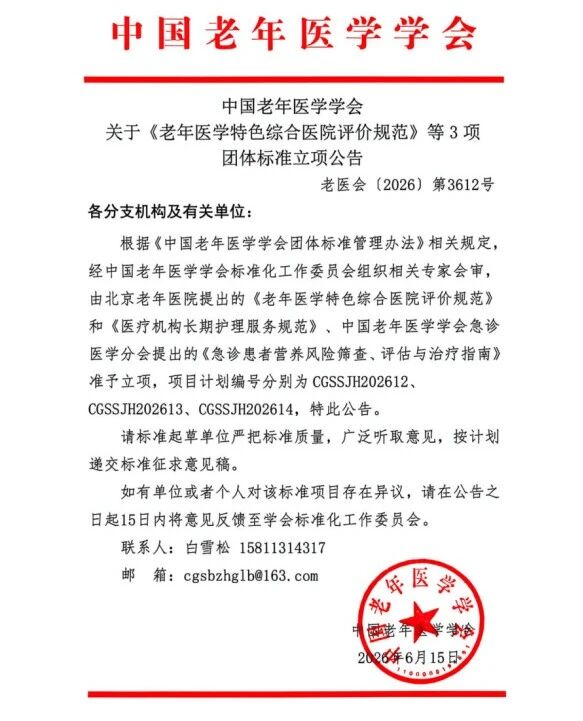

Two group standards led by the Geriatric Medical Institution Management Branch of the China Geriatrics Society have been successfully approved for project initiation
The Geriatric Medical Institution Management Branch of the China Geriatrics Society has always adhered to the concept of standardized management and empowerment by standards, and has successively formulated and released a number of group standards in the field of geriatric medicine. Recently, two group standard projects, namely "Evaluation Specifications for Specialized General Hospitals in Geriatric Medicine" and "Standards for Long-Term Care Services in Medical Institutions", organized by the branch, proposed and led by Beijing Geriatric Hospital, and jointly participated by the units of the standing committee members of the branches in Jiangsu, Henan, Hebei, Shandong, Yunnan, Guangdong and other provinces and cities, have successfully passed the project initiation review and been officially approved for initiation. This standard project is under the jurisdiction of the Chinese Society of Geriatrics and will provide a solid institutional support for the standardized, professional and high-quality development of elderly medical care and medical and elderly care services in our country.

On the morning of June 14, 2026, the project initiation review meeting for two group standards was held in the conference room of the Chinese Society of Geriatrics. The meeting was carried out strictly in accordance with the project initiation review process for group standards, focusing on a comprehensive review of the project's necessity, feasibility, coordination, scientificity and industry promotion value. At the meeting, Yu Zhen, vice President of the Chinese Society of Geriatrics, Director of the Geriatric Medical Institution Management Branch, and President of Beijing Geriatric Hospital, and Yang Yingna, Director of Beijing Geriatric Hospital, respectively led the corresponding project initiation defense. They made detailed reports on key contents such as the background of the formulation, core framework, main contents, implementation paths, and industry application prospects of the two standards. Accurately answering all kinds of questions raised by the review experts, the defense content was rigorous and detailed, closely aligned with the development needs of the industry, and was unanimously recognized by the experts. Ultimately, after comprehensive evaluation by the review experts, both group standard projects were unanimously approved and officially initiated.
With the continuous deepening of population aging in our country, the demand for elderly medical services and long-term care services is showing a trend of scale, diversification and refinement. However, at present, there is still a lack of unified and complete industry norms and standards for the construction of characteristic hospitals in geriatric medicine and long-term care services for the elderly in medical institutions in China. There are industry pain points such as inconsistent service content, uneven service quality, incomplete evaluation system and non-standard management standards, which have restricted the standardization and homogenization development of the elderly health service system. The initiation and formulation of these two group standards precisely focus on the shortcomings in the industry's development and have extremely strong practical significance and leading value for the industry.

Among them, the "Evaluation Specifications for General Hospitals with Geriatric Medicine Characteristics" will systematically establish the evaluation standards for general hospitals with geriatric medicine characteristics, clearly defining the standard requirements for geriatric medicine characteristic hospitals in dimensions such as department construction, diagnosis and treatment services, talent allocation, quality control, review and evaluation, performance assessment, and patient experience. The introduction of this standard will fill the industry gap in the standardized evaluation of general hospitals with geriatric medicine characteristics. It will provide a unified reference standard for medical institutions at all levels in building geriatric medicine characteristic departments, constructing elderly-friendly hospitals, performance assessment and evaluation, and hospital grade review. It will effectively standardize the geriatric medical service process of hospitals and enhance the professional level of geriatric disease diagnosis and treatment and health management. Promote the characteristic, standardized and brand-oriented development of geriatric medicine in general hospitals.
The "Standards for Long-Term Care Services in Medical Institutions" focuses on the essential long-term care needs of elderly people who are disabled, semi-disabled, or have chronic diseases. It formulates unified standards for key links such as the service content, operation procedures, safety management, risk prevention and control, personnel qualifications, service evaluation, and integration of health care and elderly care provided by medical institutions for the elderly. The implementation of this standard will effectively solve the problem of the lack of unified norms for long-term elderly care services in medical institutions and the difficulty in controlling service quality. It will standardize the behavior of integrated medical and elderly care services, enhance the professionalism, safety and standardization of long-term elderly care services, and truly safeguard the rights and interests of the elderly in seeking medical treatment and health care. Provide authoritative basis for medical institutions to carry out professional and refined long-term care services for the elderly.
Next, the branch will join hands with industry experts and institutions within the industry to strictly follow the requirements for the compilation of group standards, and orderly advance the entire process of the two standards, including research and argumentation, content compilation, revision and review, and public announcement and release, to ensure that the content of the standards is scientific and rigorous, closely related to clinical practice, and compatible with the development of the industry. These two group standards are planned to be officially released and implemented by the end of this year.